


Who Is Not Eligible for Overtime in UAE? (Managers & Supervisors Explained – 2026)
Working overtime in the UAE is a common thing, no matter what sector you work in, but there are some laws about overtime that protect the rights of employees and make it mandatory to give proper compensation for extra work.Overtime in UAE Let’s understand in simple words what the UAE laws say about your overtime and how these matters are beneficial for both employees and the company. It is also important to understand how it affects the company’s salary and payroll system.
Visit Now: https://www.taxsal.com/
What is overtime?
Overtime occurs when an employee works more than their scheduled duty hours, that is, the hours that exceed their scheduled or weekly work hours are called overtime. Usually, the additional hours are paid in the form of compensation or higher pay according to the employment contract, so that the employees’ right to freedom of labor and time can be paid. Overtime in UAE Those additional hours can also be those that an employee works of his own free will, but do not necessarily receive additional pay for them.
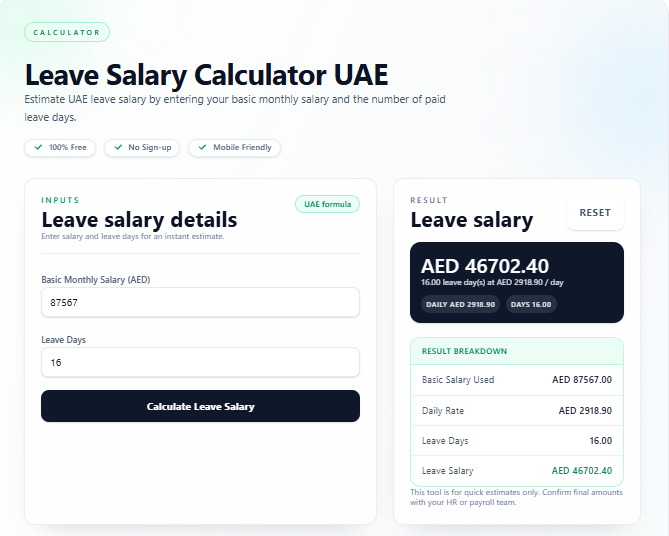
Click Here: Leave Salary Calculator UAE
UAE regulations regarding overtime
The UAE Labor Law has some clear rules to protect the rights of property security employees. Overtime in UAE According to Article 33 of the Decree No. According to Law No. 33 of 2021, the maximum working hours are 48 hours per 20 weeks.According to Article 17, the Authority has the authority to increase or decrease the working time for certain sectors or specific employees in consultation with the Minister and research institutes. In addition, decisions can also be made regarding breaks and certain employees.
Employer’s obligations
In TUAE, we have certain responsibilities for our employees.These responsibilities may vary depending on the nature of the job and the type of work performed. These may include maintaining good working conditions, providing accommodation, granting sick leave, and not keeping the employee’s personal papers or postal ballots with them, etc. Overtime in UAE These are given according to the company, and some may vary from company to company.
Here are some important points to keep in mind:
According to the law, if an employee is not on a permanent contract, then he is entitled to overtime pay for working more than the fixed time.
The time spent by an employee on his way from home to work is generally not included in working time. However, for some specific types of work, there may be different rules in the law, so the employee and the company can discuss it and decide on a better one.
Workers working on the basis of not working more than two days in a row with an employee may differ from this.
They cannot be forced to work more than the agreed upon time in the contract unless both are in Mecca in advance.
If the employee works on loan or from another place with the permission of the company, whether inside or outside the UAE, then companies can set working hours.
Read More: Unpaid Leave Rules in UAE – Employee Rights Explained (2026)
Calculating overtime compensation
Due to the working conditions of the employee, the employee will be considered overtime from the normal working hours.
The employee will receive an additional payment of 25% of his basic salary. Overtime in UAE If he has to work between 4:00 a.m. and 50% of his basic salary, he will be paid an additional payment of 50% of his basic salary.
This rule does not apply to shift employees. Overtime in UAE If the employee has to work during his Ihram, which is stipulated in the contract or company policy, he will either go on this alternative rest day or will be paid an additional payment of at least 50% of his basic salary.
Read More: Overtime for Night Shift in UAE – Is It 150% or More? (2026 Rules Explained)
In case of a dispute
According to this labor union, employees have the right to receive 25 percent to 50 percent of their salary for overtime work, but it is important to remember that there may be some conditions or differences that can affect employees’ ability to work overtime.
If the employee’s employment contract does not specify overtime hours, the employee cannot claim overtime for additional hours worked.
If there is a dispute or problem in any regard, such as a dispute over the law or wage obligations, you can contact us to find out whether you are eligible for overtime or not.
Read More: Overtime on Public Holidays in the UAE—125% or 150% Pay? (2026 Guide)
Conclusion
By understanding the UAE’s overtime laws and regulations, employees can protect their rights, compare scenarios, and make the right decision about working overtime and being punctual.UAE Overtime Rules However, it is also important that employees are informed about the financial benefits and opportunities to improve their skills.
FAQ’s
What is Overtime in UAE and how does it work?
Overtime occurs when an employee works beyond their regular daily or weekly working hours. According to UAE labor law, employees are entitled to extra pay for overtime to compensate for the additional effort and time they spend at work.
Who is eligible for Overtime in UAE?
Generally, employees who are not managers or supervisors are eligible for overtime. Eligibility also depends on the employee’s job role, the nature of the work, and the employment contract.
How is Overtime in UAE calculated?
Overtime pay is usually based on the employee’s basic salary. The standard rates are:
At least 25% extra for hours worked beyond regular working hours
At least 50% extra for work between 10 PM and 4 AM
The calculation depends on the employee’s basic wage and the number of overtime hours worked.
How does Overtime in UAE affect payroll or salary?
Overtime increases the employee’s monthly salary. The company includes overtime hours and extra pay in the payroll system to ensure that the employee receives the correct compensation.
Are managers and supervisors entitled to Overtime in UAE?
Generally, managers and supervisors are not eligible for overtime. This is an exemption under UAE labor law. However, some companies may provide overtime pay for these roles based on internal policies or specific employment contracts.