

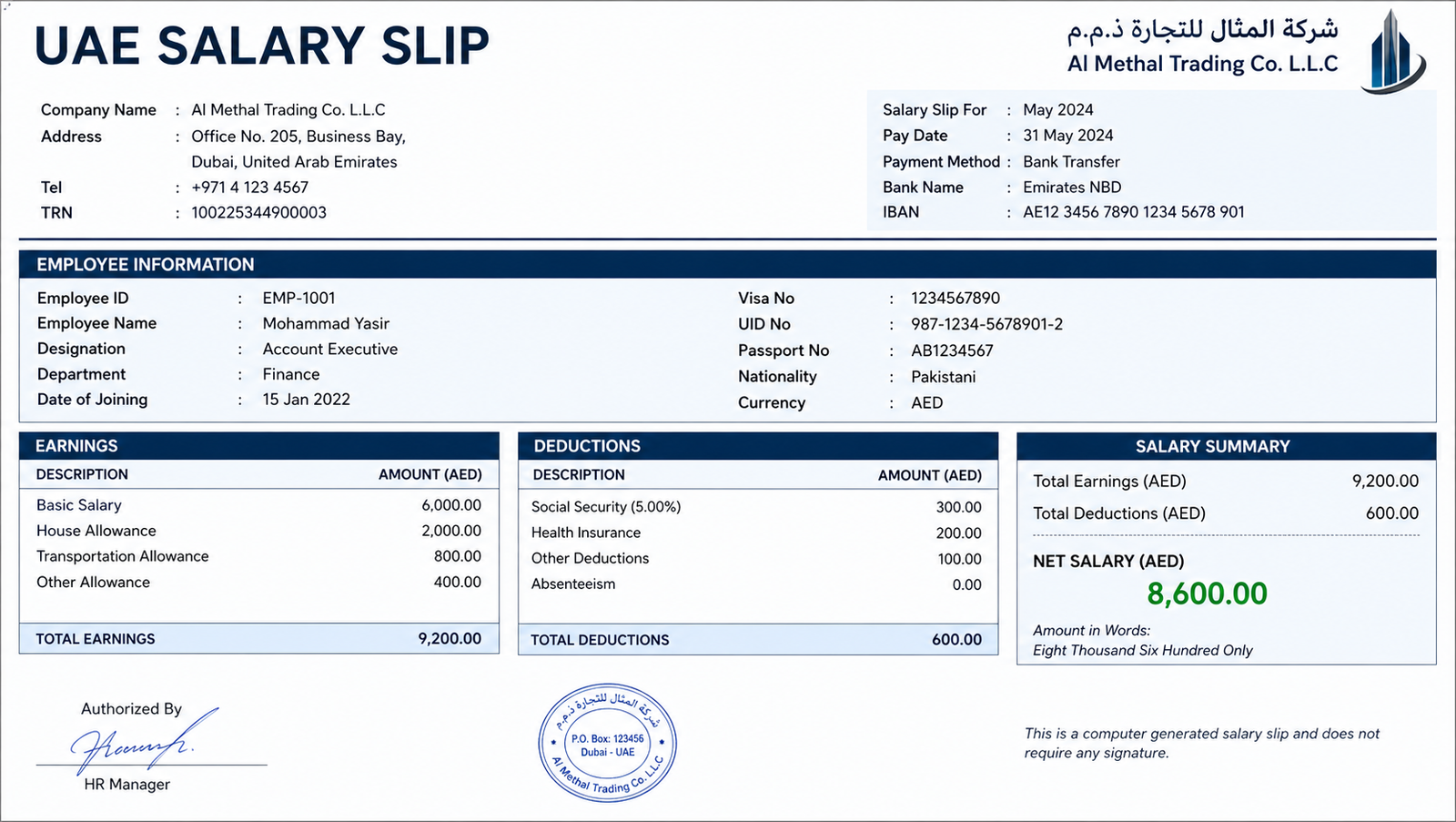
UAE Salary Slip Explained (2026 Guide): Basic, Gross & Net Salary Breakdown
UAE Salary Slip Explained Payroll or compensation forms a crucial element in terms of recruiting and retaining employees within the business. An effective and efficient payroll procedure also plays a huge role in increasing the satisfaction levels of the employees and engaging them in the work they do. Particularly when one takes into account the rules set out by the WPS (Wage Protection System), which ensures that employees’ rights are protected from any form of exploitation according to the labour law, proper management of salaries becomes necessary in order to run a successful payroll management process.
UAE Salary Slip Explained The first step towards developing an effective payroll management process requires a thorough understanding of the structure and elements included within the UAE salary slip. Salary slips, or payslips, give the company’s payroll department clear insight into the firm’s financial standing and how much it spends on human capital management.
Visit Now: https://www.taxsal.com/
What Is a Salary Slip?
A salary slip, also known as a payslip, is a document provided by the employer to employees, giving a clear breakdown of their salary for a given period of time, depending on the type of employment in the company.
Basically, the structure of a payslip format in the UAE and all over the world usually consists of basic elements like basic salary, allowance, deduction, and net pay. Payslips are used to provide documentation regarding the money paid to employees.
Employees can view the payslip as a monthly statement of their income and net salary. It helps them understand the company’s benefits and reduce payroll disputes.
On the other hand, for employers, salary slips enhance transparency in their payroll process and build trust with the employees, reducing turnover rates influenced by poor salary management practices.
Legal Requirements in the UAE For Salary Slip
In many parts of the world, it is a legal mandate for employers to provide their employees with an approved salary slip format within their pay cycle. This format specifies all the necessary information on what a payslip should include.
In the event an employer fails to comply with these laws, it can result in heavy fines, court appearances, and even lead to receiving an infringement notice for the company.
In contrast, it is not compulsory from a legal standpoint for the employer to provide either a physical or electronic salary slip in the UAE at every pay period, except if it is stipulated in the employment contract.
On the other hand, the provision of a salary slip is highly recommended, as it adheres to some of the standards established by MOHRE and WPS.
Employees Can Request Payslips From Employers
Although the issuance of payslips is not legally required, workers have the right to demand them as evidence of their salaries and deductions. Employers must give workers salary slips, even in hard copy, if demanded by them.
But if the issue continues unresolved and a worker has not been given his/her rightful payslip for over two months, he/she may lodge a complaint before the Ministry of Human Resources and Emiratisation (MOHRE).
WPS & Salary Transfer File (SIF) In The UAE
The United Arab Emirates has a Wage Protection System (WPS). UAE Salary Slip Explained This means that all private firms in the country must ensure that they remit the salary through banks that have been authorised for such purposes.
Also, the companies must ensure that they release salaries on a particular day, and this cannot be beyond 10 days from the payment date. If nothing has been mentioned in the employment agreement, then the salary should be released by the company to its employees after every 14 days.
Although the WPS does not mandate a salary slip format in the UAE, it encourages a structured payroll process that includes detailed records of payments, which a simple payslip includes.
This is because the Ministry of Labour instructs companies to maintain a Salary Transfer File (SIF) to comply with WPS when running a payroll system in the country.
The SIF is a comprehensive and updated employee file that includes details like the basic salary of different employee categories, contact details, allowance types, gross salary, net pay, and, more importantly, the type of deductions made from the employee’s salary.
Employee ID
The accepted payslip format in the UAE should have a unique employee ID. UAE Salary Slip The company’s payroll system usually creates this number to keep records of its employees.
Employee identification numbers are always unique and are one of the key components of what a payslip should include.
As a standard format, companies in the UAE employ the initial two characters for the company’s initials, the next two for the year, and the final two for the employee number.
Payroll Processing Details
According to the regulations covering the WPS system in the UAE, private sector organisations should pay employees’ salaries via banks, authorised financial firms, and the Bureau de Change. UAE Salary Slip The IBAN (International Bank Account Number) is typically issued to banks and companies registered under the Wage Protection System (WPS) in the UAE.
This code is responsible for recognising the salaries that go through WPS (Wage Protection System) to pay employees their salaries.
Bank details must include the name of the bank, the account details, and the International Bank Account Number (IBAN). The IBAN is made up of 23 characters, including a two-letter country code, two digits check number, three letters bank code, and 16 numbers for the bank account number.
Knowledge of these details is important in the correct formation of a payslip.
Read More: Leave Encashment in UAE (2026 Guide): How to Calculate Unused Leave Salary
Company Details
This is another important component of what a payslip should include. UAE Salary Slip The company name, address, and the fortnight or month the salary slips are prepared are details that need to be filled in here.
Company Tax Code
Companies that are required to pay any form of tax are assigned a unique tax code. This code usually refers to the amount deducted from each paycheck. In the UAE, businesses will also have to withhold 5% of local employee wages as a pension contribution. This doesn’t apply to foreign workers.
Employee Attendance
A payslip format in the UAE should include the payable days of employees. If an employee has not taken any holidays, the total number of days worked should be listed. If holidays are taken, they should be subtracted from working days and offset with allowed leaves. Sick pay, pregnancy, or paternity leave should be separately mentioned on the payslip.
Basic Salary
This component in a salary slip format in the UAE refers to a fixed portion of an employee’s compensation before any other elements, such as allowances or bonuses, are added and deductions in the form of tax and unpaid leave are made. UAE Salary Slip Explained It is the basic salary to which other salary components like house rent allowance (HRA), medical allowances, and benefits are calculated.
Basic salary is calculated as a certain percentage of the total gross salary, and it also forms the primary basis for calculating end-of-service benefits in countries like the UAE.
In many companies, it ranges from 40% to 60% of the gross salary, depending on the organisation’s pay structure and regional guidelines.
Basic Salary=Gross Salary×Basic Salary Percentage
Allowances
Allowances refer to additional financial advantages offered to employees by their employer apart from their base salary. Some of the common allowances that can be included in a payslip format in the UAE are housing allowances, medical allowances, travel allowances, conveyance allowances, etc. These allowances form part of the total salary paid.
Deductions
These are some of the deductions that may be made from the gross salary of an individual in the salary structure. It affects the net salary or the take-home salary of an individual. UAE Salary Slip Some of the deductions may include taxes, social security contributions, health insurance, unpaid leave, and loan repayment.
Overtime and Bonuses
In the UAE, overtime is any time beyond the regular 48-hour week. For the first two hours of overtime, an employee is paid 1.25 times the rate and for other hours worked, the rate is 1.5 times more than the regular rate. Overtime is subject to managerial approval and governed by labor law.
Overtime is shown on a payslip as a distinct line showing the number of overtime hours worked and overtime wages earned based on the relevant rate.
In contrast, a bonus in the UAE is a reward given to the employee based on performance; usually, bonuses are paid once a year. Bonuses are non-obligatory, depending on the company’s discretion, and they boost the morale and commitment of the employees.
A bonus is also a distinct item on the payslip with the bonus amount given during that period.
Overtime and bonuses are both included in the computation of gross salary.
Net Salary
Net Salary is the sum that the employee receives in the end after deducting all the necessary amounts from the gross salary, including overtime and bonuses. UAE Salary Slip The sum shows how much money the individual can use personally. It must be listed on the payslip.
Read More: Basic Salary in UAE Explained (2026): Difference Between Basic, Gross & Net Salary
Good To Know
This depends on the organization itself, but CTS (cost to the company) can be said to be one of the elements that form the payslip. UAE Salary Slip The cost to the company is basically the total cost to the employer for hiring a particular person, which involves everything from his basic salary to bonuses.
In essence, this is all the expenses incurred in hiring employees, although it need not necessarily be included in the payslip. But there may be some organizations that include it at the bottom of the payslip format in UAE.
What to Do if You Find an Error in Your Payslip
When employees find an error in their payslips, they should take the following steps:
- Review the Payslip
- Gather Documentation
- Notify HR or the Payroll Department
- Explain the Issue
- Follow Up
- Request a Correction Until Resolved
Conclusion
Salary slip structure must be understood by both employees and employers in the United Arab Emirates. UAE Salary Slip Explained The payslip provides a complete breakdown of all essential elements, which include basic salary, all allowances, total deductions, overtime payment, bonus amounts, and final net salary that the employee will receive. The UAE requires employers to provide salary slips as a legal obligation but these documents serve as essential tools which help establish business transparency and trust between parties while also supporting correct payroll operations. Companies that implement proper payroll methods while fulfilling Wage Protection System (WPS) requirements will experience reduced workplace disputes and increased equitable treatment for their employees.
FAQS
What is a UAE Salary Slip?
A UAE Salary Slip is a document provided by an employer that shows a detailed breakdown of an employee’s salary, including basic pay, allowances, deductions, and net salary for a specific pay period.
Is a UAE Salary Slip mandatory for employees?
A UAE Salary Slip is not always legally mandatory in every company, but it is considered good practice because it provides transparency and helps employees understand their salary structure.
What information is included in a UAE Salary Slip?
A UAE Salary Slip usually includes employee details, basic salary, allowances, overtime, deductions, bonuses, and the final net salary that the employee receives.
Why is a UAE Salary Slip important for employees?
A UAE Salary Slip is important because it helps employees track their earnings, verify deductions, and use it as proof of income when applying for loans, visas, or financial services.